
Stories from Hackcessible
Discover the experiences of disabled co-designers and students who are creating a more accessible future through collaboration, creativity and making.

Chris with staff and students from Newcastle University
Chris Griffiths: Keeping the music playing
Professional French horn player Chris Griffiths has spent more than sixty years making music. He performed with the Royal Northern Sinfonia for over twenty years before becoming a freelance musician, teacher and conductor. Throughout his career, music has been central to his life.
Living with Charcot-Marie-Tooth (CMT), a neurological condition that causes progressive weakness in the hands and feet, Chris had adapted to many challenges over the years. Twelve years ago, he elected to undergo a double amputation, enabling him to remain active and independent. As the condition continued to affect his hands, however, playing the French horn became increasingly difficult.
The French horn presents a unique challenge. Its weight is supported by the right hand, while the left operates just three valves. The right hand also sits inside the bell, where even small changes in position affect the instrument's tone and tuning. Although Chris had already switched to the lightest horn he could find, supporting the instrument was becoming painful.
Working with Chris over five weeks, a team of engineering students explored a wide range of possible solutions. They researched existing assistive devices, investigated mechanical and electronic concepts, and developed a series of prototypes that balanced stability, comfort and practicality. Every design decision had to respect the needs of both the musician and the instrument: the support had to be lightweight, protect the horn from damage, avoid affecting its sound, and still allow the freedom of movement needed to perform naturally.
The final solution combined a lightweight aluminium and carbon-fibre support stand with a bespoke 3D-printed mounting bracket. Using two different printed materials created a secure attachment while protecting the horn from scratches, and the adjustable stand carried the instrument's weight without restricting movement.
The impact was immediate.
"Straight away my hand is straight in the bell, which is how it should be. Amazing!"
As Chris continued playing, he discovered another unexpected benefit. The support allowed him to rotate the horn naturally, making it easier to drain condensation from the instrument between pieces—a small but important detail that experienced horn players know all too well.
The horn stand went on to win best project at Hackcessible 2021. More importantly, it enabled Chris to continue doing what he loves: performing, teaching and making music.

David with his team at the inaugural Hackcessible in 2018
David Statham: From a sketch to a solution
Sometimes the best ideas begin with a simple sketch.
For David Statham, living with a progressive muscle-wasting condition meant gradually losing the use of both legs and his left arm, while retaining only limited strength in his right. Existing assistive devices could support his arm, but they were often large, cumbersome and impractical for everyday life, making it difficult to move freely in his wheelchair or through doorways.
Rather than accepting those limitations, David had an idea for something simpler.

David's original sketch
He sketched out a basic concept. But how could he develop it into a working product?
David shared his concept at the first Hackcessible event, where engineering students, disabled participants and clinicians came together to discuss challenges and possibilities. What began as a conversation quickly became a collaborative engineering project.
The initial prototype was built during the 48-hour Hackcessible make-athon. Over the following year, students continued developing the concept alongside their studies, refining the design through successive iterations. By using 3D printing, they were able to produce lightweight, low-cost components that could easily be adapted to suit different users by changing only a handful of design parameters.
As the project progressed, the team explored two complementary approaches. One developed a battery-powered arm support controlled by flex sensors in the user's fingers, while the other created a purely mechanical device using springs to assist arm movement. Alongside the engineering, the students also investigated manufacturing, commercialisation and routes to bringing the product to a wider audience, including participation in the Institute of Coding's Startup Summer programme.
For David, seeing the project evolve was extraordinary:
"It's become a reality now... from a fag packet drawing of mine and a basic wish... to an actual product which can be worn and used, giving great assistance to myself and others."
Hackcessible gave David's idea room to grow. What began as a personal challenge became an engineering project, then a prototype, and ultimately the foundation for a product with the potential to benefit many more people.

David tests out the second-stage prototype
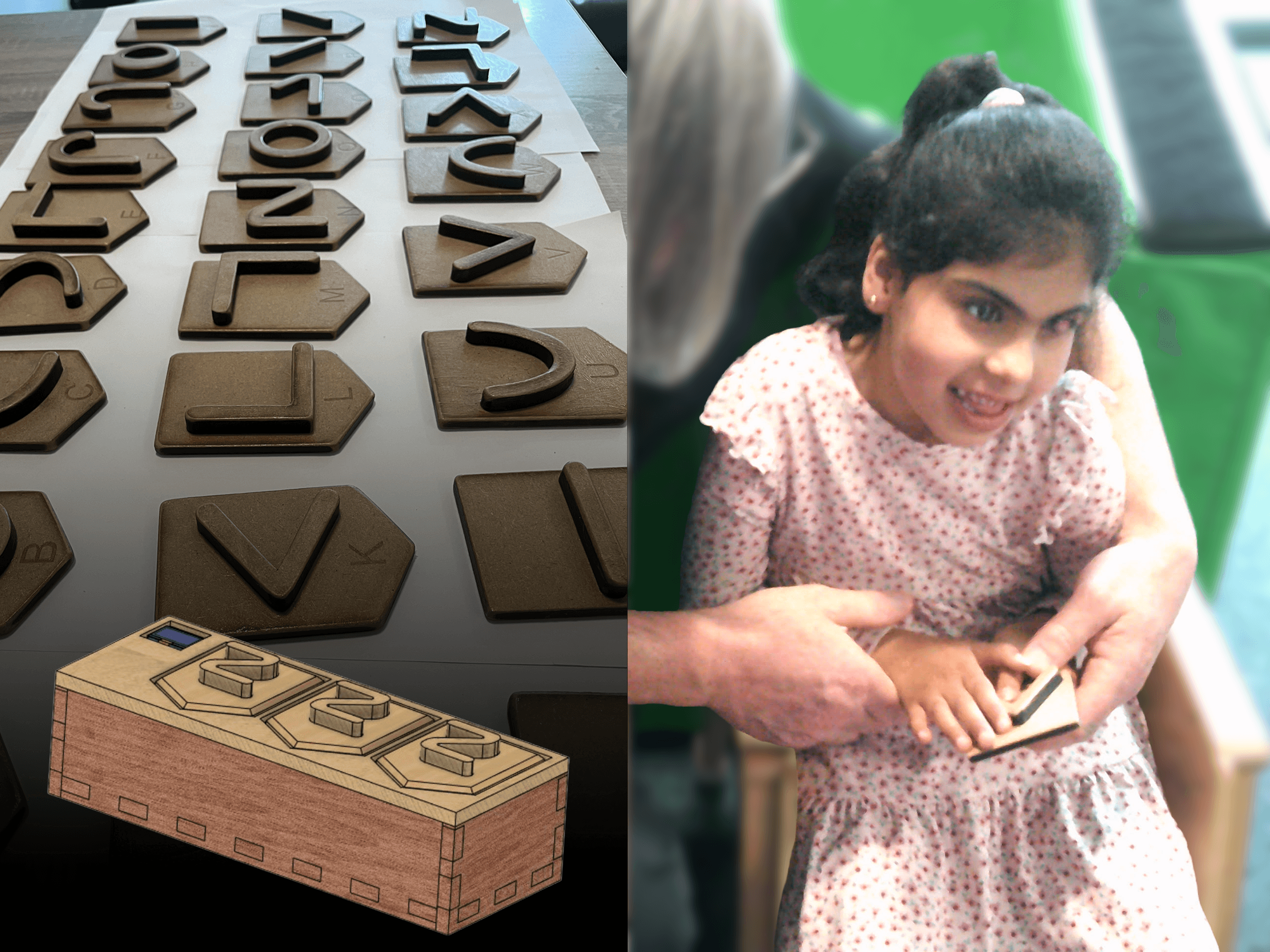
L: Moon letters and design for smart device; R: Ruqaya using the Moon letters with her teacher
Team Ruqaya: Helping a young girl learn to read
Steve Walker, a teaching assistant at Archdale School for children with Special Educational Needs, came to Hackcessible seeking help for one of his students, a five-year-old girl called Ruqaya.
Ruqaya was completely blind and just beginning to learn to read using touch. Steve wanted to introduce her to Moon type, a tactile alphabet made up of raised curves, lines and dots. While Braille is more widely recognised, Moon can provide an important stepping stone for some blind learners. The challenge was that there were very few resources available to teach it. Steve had even tried making Moon letters himself using card and a glue gun, but they were fragile, difficult to feel and unlike the symbols found in books.
At Hackcessible 2023, a team of Bioengineering and Robotics students came together to explore with Steve and Ruqaya what a better solution could look like.
Their concept, LunarTouch, combined a set of durable tactile Moon letter tiles with an interactive audio learning system. Each wooden tile contained an RFID tag which was recognised when placed on a reader, allowing the device to play the corresponding phonetic sound. Importantly, the tactile tiles could also be used on their own, ensuring Ruqaya's learning would not be delayed while the electronic system continued to be developed.
Turning that concept into a finished product was not straightforward. The team encountered manufacturing setbacks during the production of the tactile letters, but remained determined to ensure Ruqaya received a complete set that she could begin using in school. Their commitment was recognised when Team Ruqaya was awarded the runner-up prize for Hackcessible 2023.
The project did not end there. After Hackcessible, the team received a Summer Creators grant from the University of Sheffield's Emerge enterprise programme, enabling them to continue developing LunarTouch and explore how the idea could grow beyond the original prototype.
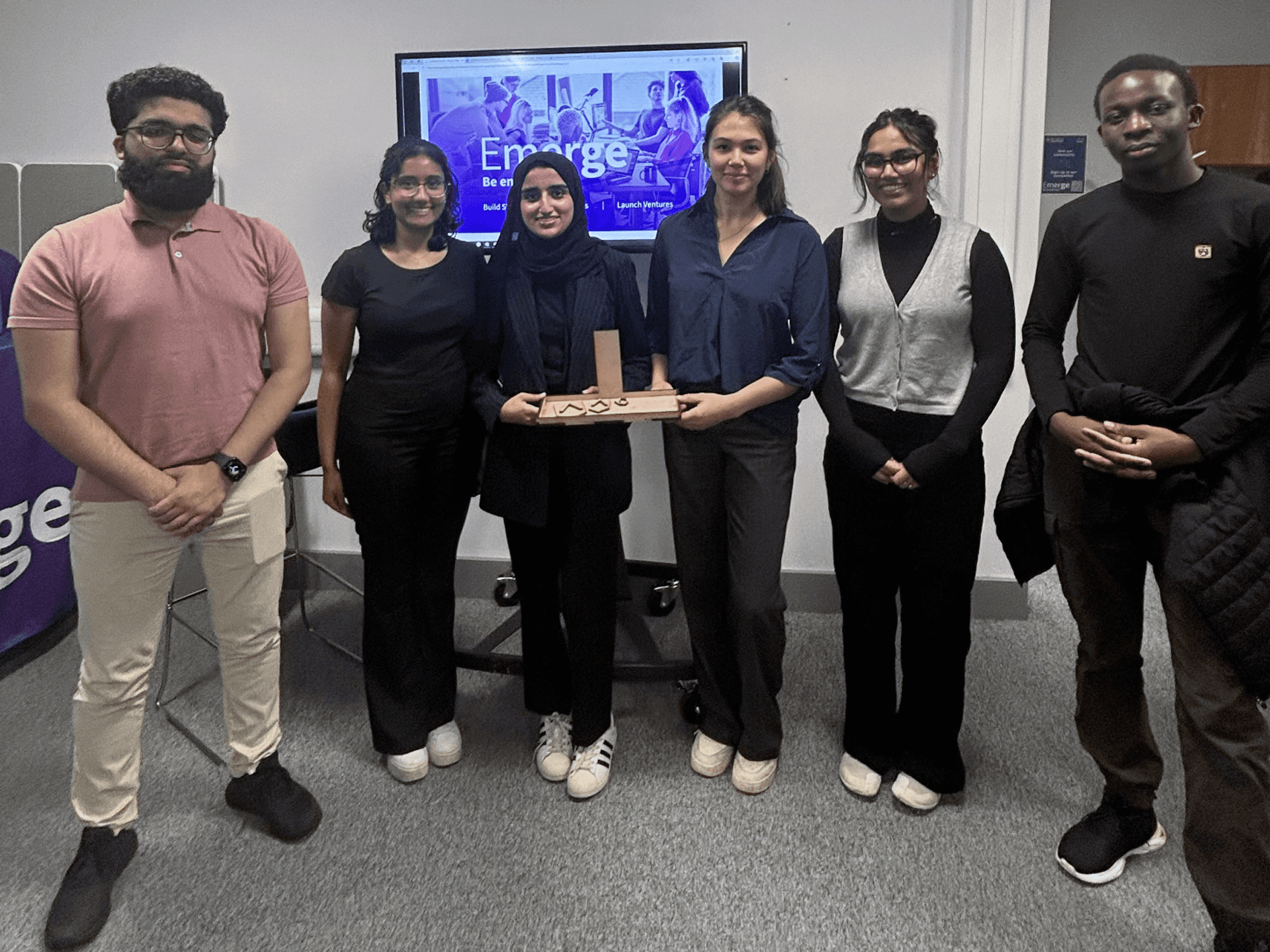
Team Ruqaya presenting LunarTouch at the Emerge Collective
Most importantly, Ruqaya began using the Moon letter tiles in her classroom.
"Ruqaya has already started using the Moon letter tiles. She uses them during circle time to identify her friends' names. Whilst an adult helps her to trace the letter shape and says the initial sound, Ruqaya is able to identify who is next in the circle and say their name."
— Steve Walker, Teaching Assistant
As Ruqaya's confidence grew, she exceeded her teachers' expectations and progressed to learning Braille. Looking back, Steve reflected on the part the project had played in that journey:
"The Moon symbols provided by Team Ruqaya played an important role in getting her to this stage in her communication journey."
Steve had set out to help one child learn to read. But through combining his specialist teaching knowledge with a talented and determined group of students at Hackcessible, the result was not only a working product that made an immediate difference to Ruqaya in the classroom, but a resource with the potential to benefit many more visually impaired children in the future.